
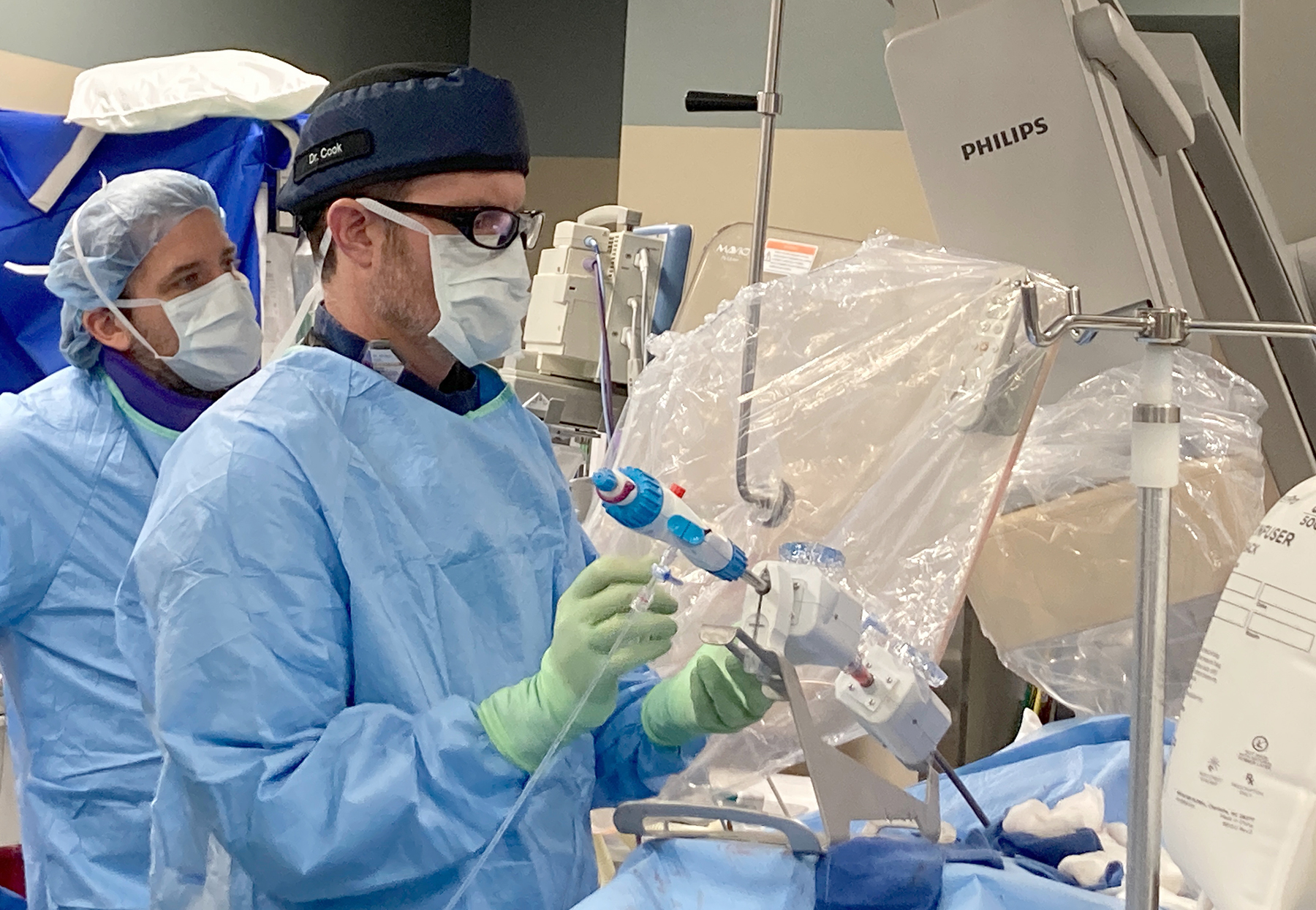
A new minimally invasive procedure at Blessing Hospital means more patients can stay in the area to get potentially lifesaving heart care. The first transcatheter edge-to-edge repair – or TEER – at Blessing was performed on Monday, January 19 by cardiologist Jeffrey Cook, MD, with the assistance of fellow cardiologist, Farooq Junaid, DO.
TEER repairs a leaking mitral heart valve. According to Mayo Clinic, one of the conditions caused by a leaking mitral valve, called mitral valve regurgitation, is the most common type of heart valve disease, affecting about 10% of adults, particularly those over age 75.
What does the mitral valve do?
The two flaps on the mitral valve open to let oxygen-rich blood flow into the heart from the lungs and then close to allow the blood to be pumped from the heart to the rest of the body. When the flaps malfunction, it can lead to a condition known as mitral valve regurgitation, which is blood flowing back into the atrium of the heart instead of out into the body.
Symptoms of mitral valve regurgitation can include shortness of breath, heart murmur and fatigue. In severe cases, symptoms may include irregular heartbeat; fluid buildup in the lungs; heart failure; cardiac arrest, which is when the heart suddenly stops beating, or stroke.
During the TEER procedure, Dr. Cook leads a catheter – carrying a clip – through the leg and into the heart to the mitral valve. Upon reaching its destination, the clip is placed to bring the two valve flaps together, reducing backflow of blood into the atrium of the heart.
“It is very minimally invasive, even less invasive than some of the other valve procedures we do,” said Dr. Cook.
The procedure is performed in Blessing’s cardiac catheterization lab by an interventional cardiologist (Dr. Cook), using live x-ray and also the assistance of an imaging expert with advanced training in transesophageal echocardiography (Dr. Junaid). A transesophageal echocardiogram is a minimally invasive diagnostic ultrasound that creates high-resolution images of the heart’s structure and function from inside the body.
Who is a candidate for TEER?
The first line of treatment for mitral valve regurgitation is open heart surgery, during which the valve is surgically repaired or replaced. While this remains the gold standard of care, TEER may benefit patients who cannot have open heart surgery.
“The most likely candidate for TEER is someone with a severely leaking mitral valve that is feeling unwell – short of breath and with other symptoms of heart failure – but is a poor candidate for open heart surgery because of things like advanced age, lung disease or reduced cardiac pumping function,” Dr. Cook said. “Those patients may be better candidates for TEER because it is minimally invasive.”
Before TEER, most patients with severely leaking mitral valves who were not candidates for open heart surgery had to be referred to Barnes-Jewish Hospital in St. Louis for TEER.
Another minimally invasive valve procedure, transcatheter aortic valve replacement (TAVR) has been done at Blessing Hospital for over 5 years. Now TEER, for mitral valve regurgitation, is also available at Blessing.
“In the right patient, TEER works well to improve mitral valve regurgitation and its symptoms,” Dr. Cook said.
He adds there are different reasons for a leaky mitral valve. Patients require a workup to assess the cause and determine appropriate treatment options.
For more information on TEER, call the Blessing Cardiology Valve Clinic at (217) 214-3444.