
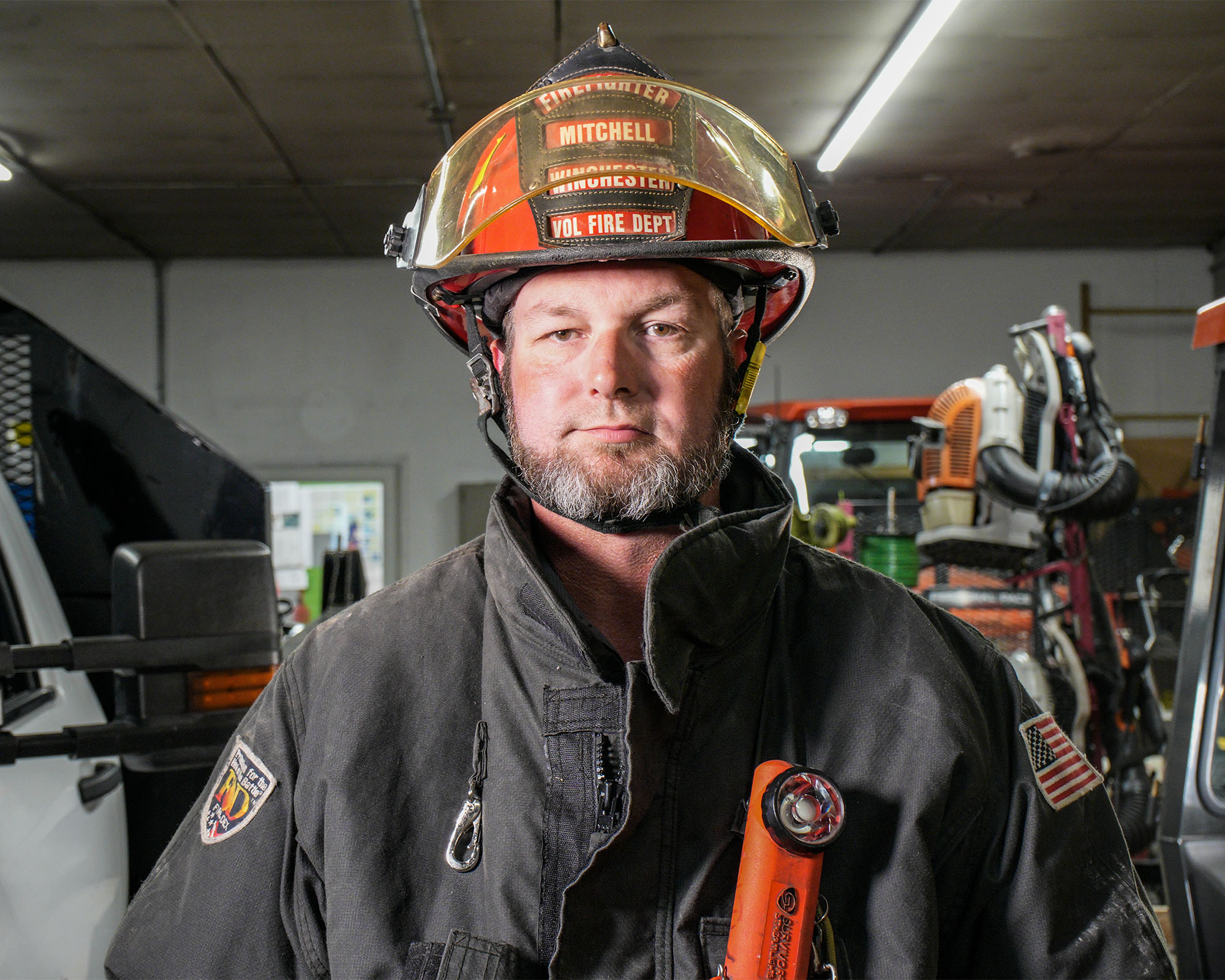
According to Google, calling someone ‘a pistol’ means they are, “high-energy, spirited, witty or feisty, often with a charmingly unpredictable or mischievous personality.”
Stacey Mitchell is a pistol.
The 43-year old was born, raised, and lives in the Scott County community of Winchester, Illinois. He is a diesel mechanic, tow truck driver, volunteer fireman, husband and father of two teenage daughters. People who know Stacey will tell you he occasionally uses salty language and loves his family, friends and community unconditionally.
“I am the type of person who won’t quit,” he said. “My boots get put on as soon as I get out of the shower in the morning and they don’t get taken off until I hit the bed.”
That all changed on Christmas Day 2025.
What happened?
While grilling dinner for his family, Stacey tripped coming back into the house.
“He fell on his face and the food went flying,” recalls wife, Victoria. “He hit his face off the counter. He was very upset. He walked a little funny after that. We just knew something wasn’t right.”
Victoria was right. What happened to Stacey on Christmas Day was just the beginning. Over the next several weeks his condition deteriorated mysteriously and rapidly.
“It was like one day he went to bed and he was fine and the next day he woke up and it just all went downhill. He could no longer step over the edge of the tub to take a shower,” she recalled. “He could barely walk.”
Stacey’s decline eventually led to the loss of all feeling below his waist. He called his wife at work on that day in January 2026, asking to be taken to the hospital.
“He’s not a person that goes to the hospital,” Victoria said.
What’s wrong?
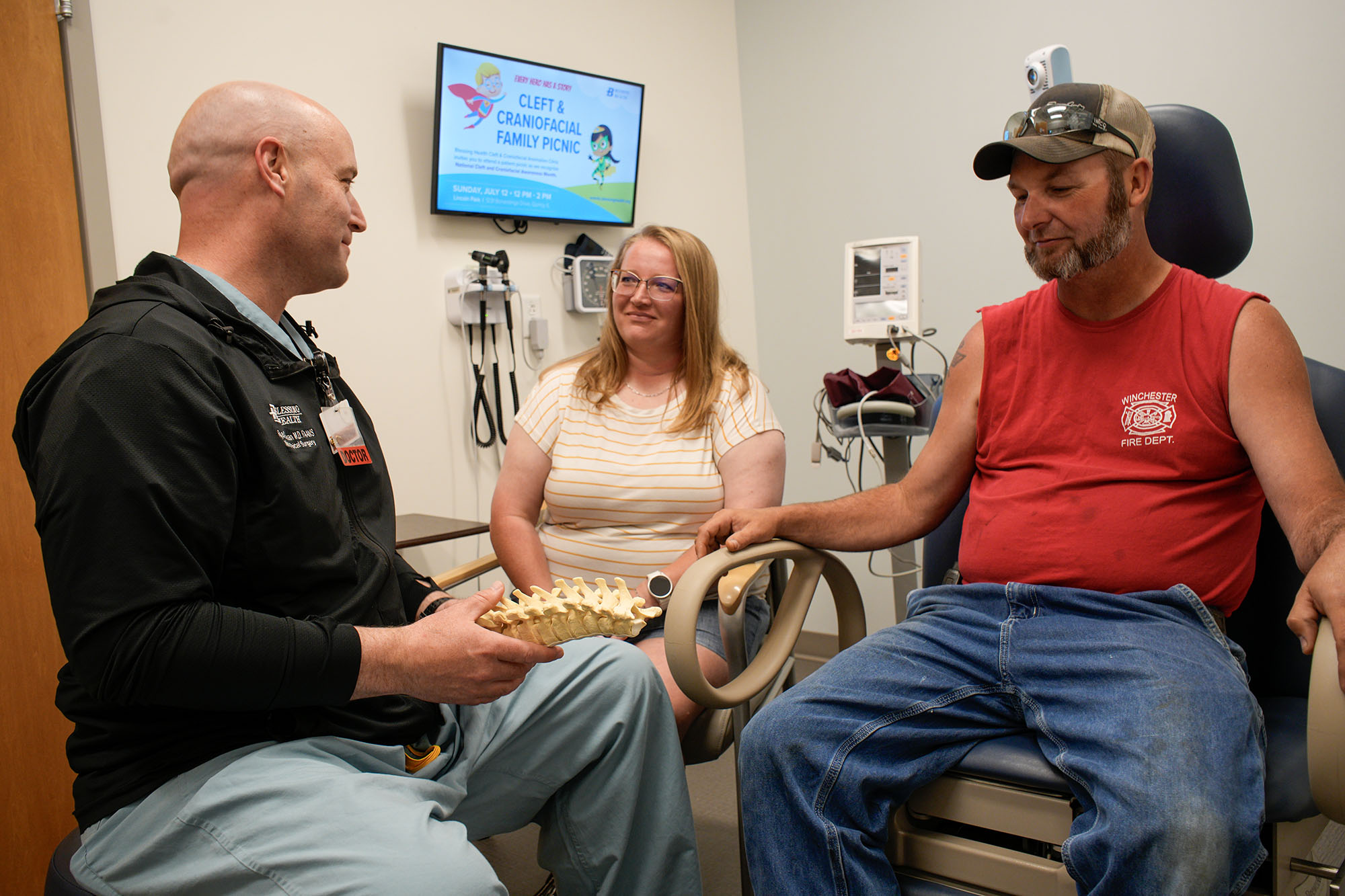
After being seen by doctors at two other area hospitals and told no cause for his condition was apparent, Stacey called a man whose car he used to work on years before - Dr. Darr Leutz, an orthopedic surgeon at Blessing Health - asking for the name and contact information of a doctor who could help him.
Dr. Leutz, recognizing the seriousness of Stacey’s symptoms, gave him the phone number of Blessing Health neurosurgeon Dr. Ryan Brennan’s office and told Stacey to call immediately.
Dr. Brennan completed fellowships at the Cleveland Clinic and Massachusetts General Hospital (Harvard Medical system), in addition to a neurological surgery residency at the Cleveland Clinic.
Upon calling Dr. Brennan’s office and explaining his situation, Stacey was told to come to the Blessing Hospital Emergency Center immediately.
“I got to Quincy and they were waiting for me in the ER,” Stacey said. “I spent three days in the hospital.”
Over those three days, Stacey underwent a battery of tests, including a three-hour MRI, and his condition was stabilized. The results of the testing showed his spine was critically compressed from the base of his neck to the bottom of his rib cage.
“The compression was so severe that the neurological signals from Stacey’s brain to his body were being choked off, causing his walking problem and eventual loss of feeling below the waist,” explained Dr. Brennan. “This is uncommon in a patient his age.”
Stacey’s condition was deteriorating rapidly, and without treatment, it would inevitably lead to paralysis, the doctor added.
Although there is no way to know absolutely, Dr. Brennan believes Stacey’s spinal compression was likely caused by trauma earlier in life that finally presented itself after tissues grew overly thick and calcified, forming hardened masses at several levels of the spine. Stacey says the trauma may have been the result of his years of participation in demolition derbies.
What’s the answer?
To return the flow of signals from Stacey’s brain to his body, Dr. Brennan would need to drill within 1 millimeter of Stacey’s spinal cord – that’s the thickness of a credit card – in order to remove the excess bone growth that was smashing the spinal cord. The stakes were extremely high. Any error could result in a devastating spinal injury and permanent paralysis.
In addition to his exceptional training and skill, Dr. Brennan would use Blessing Hospital’s state-of the-art StealthStation neuro-navigation system to provide real-time 3D visualization to help guide the high-speed drill he would use to restore Stacey’s ability to walk and the sensation below his waist.
The doctor explained the procedure and risks thoroughly to the Mitchells/
“I wanted them to know that, while the risks are very real, we are in this journey as a team, and I am going to help them through every step along the way before, during and after surgery,” Dr Brennan explained. “They will get the quality of care I would want for myself, my family, or my loved ones. Together we would ensure the best possible outcome.”
“I was basically paralyzed before the surgery. I had to take the risk. I had to do something. I was in pain,” Stacey said. “Dr. Brennan told me, ‘I want you to be able to walk your daughters down the aisle and I want you to be able to dance with your wife.’”
“Dr. Brennan treated us like we were part of his family. He made us comfortable,” Victoria added. “We put our trust in him.”
What was the outcome?
Thanks to the exceptional work of Dr. Brennan, the incredible operating room staff, and the world class nurses at Blessing Hospital, Stacey’s surgery was an overwhelming success. Within the first two hours after the mid-February operation, Stacey walked down the halls of Blessing Hospital barely needing the aid of a rolling walker. At two weeks after surgery, he no longer needed any help as he walked with ease. By six weeks after surgery, Stacey returned to work, was answering fire calls, and was able to again enjoy time with his family.
“The first time I got to see him go up a set of stairs I felt like a new mom and my child was just learning to walk. I teared up,” Victoria said. “It has been too long since he had been able to do the things that he enjoys.”
“Blessing Hospital and Dr. Brennan are phenomenal,” Stacey declared.
For more information on neurosurgical care at Blessing Health System, go to blessinghealth.org/neurosurgery.