

At the Blessing Clinical Research Department, we contribute to medical knowledge and assist in advancing science. The Blessing Clinical Research Department offers different types of clinical trials including medication, devices, psychotherapy, new approaches to radiation therapy, surgery or a combination of these mentioned, Diagnostic, Prevention, Quality of Living, Screening, and Genetic studies. View active clinical studies here.
Clinical Research: What You Should Know
Experience the Blessing Difference: When you come to Blessing to participate in a clinical research study, you benefit from the following:
- Expertise: Our physicians and advanced practitioners, receive additional research specific training to become clinical investigators, and are supported by a team of individuals who are experienced and trained in conducting clinical trials.
- Exclusive treatments: You gain access to various treatment options available to you, including clinical trials which allow access to cutting-edge therapeutics and devices, before they are FDA approved.
- Convenience: Our patients will have access to the most promising clinical trials without the burden and expense of long-distance travel. Through our partnership with major pharmaceutical companies responsible for developing new interventions, our physicians determine which clinical trials would be most beneficial for our community. We make it easy for you to get all of your needs met and follow-up care in one easy-to-access location.
- Improved Outcomes**: People who participate in clinical trials may have a better quality of life and increased patient satisfaction. Throughout the duration of the clinical trial, our patients who participate in clinical research studies, receive extensive support, including close monitoring, access to necessary laboratory/diagnostic tests, ongoing medical care, education and counseling.
Clinical Trials at the Blessing Research Department
The clinical trial process is very stringent, step-wise process that collects information about new medications or devices before they are approved.
Clinical trials help us advance medicine by developing new medicines and medical devices. At the Blessing Clinical Research Department, we aim to improve how we prevent, diagnose, and treat conditions and diseases. Once an approach has shown promise in a laboratory, we need to test it with many volunteers. All clinical trials go through multiple types of review committees including those that focus on scientific review and ethical review.
Why Participate?

Access To Alternate Treatment: Participating in a clinical trial will give you access to the latest in interventions, techniques and medicines. You will receive personal attention from the top health care providers in our area.
Active Decision Making: As a patient, choosing to participate in a clinical trial is a personal decision. You may want to speak with your doctor, family members or friends about your decision. There are advantages and risks associated with clinical trials. You can always change your mind and decide to leave the study at any time.
Hope: Participating will give you an opportunity for improvement of your condition. In addition, you will receive personal attention from the top healthcare providers in our area.
Altruism: Expanding our medical knowledge about your condition and new approaches on ways to treat your condition. Also, by participating, you are helping to improve health care for everyone in your community.
Frequently Asked Questions
What is a Clinical Trial?
As defined by NIH, a clinical trial is a research study performed in people, that are aimed at evaluating a medical, surgical, or behavioral intervention. They are the primary way that researchers find out if a new treatment is safe and effective in people.
Clinical trials must be conducted before a new drug, biologic or device may be marketed in the United States. The Food and Drug Administration (FDA) regulates clinical trials. The FDA gives investigators permission to test a new drug, biologic or device under strict regulatory conditions.
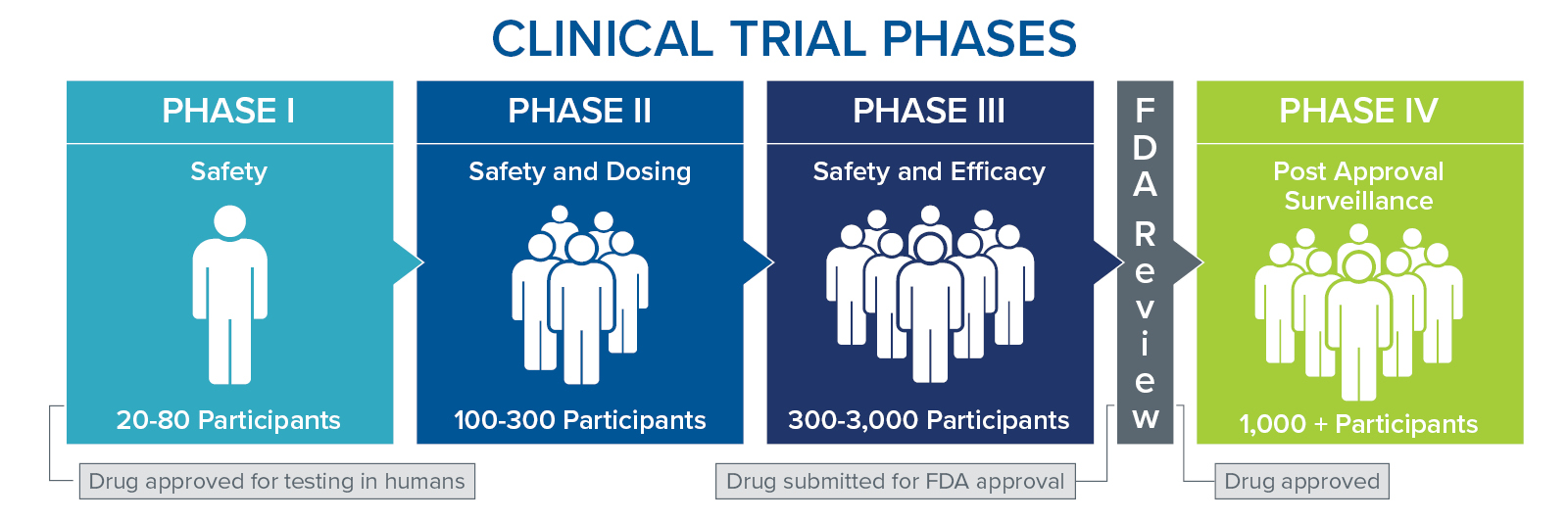
What are the phases of a Clinical Trial?
- Phase One: Tests an experimental treatment (ie: Drug or Device) on a small group of healthy people to test its safety and side effects and to find the appropriate drug dosing. There are usually about 20-80 enrolled in this phase.
- Phase Two: Uses a larger study group, approximately 100-300 people. This phase focuses on the drugs effectiveness. The aim is to obtain data on whether the drug works in people with a certain disease or condition, as well as continue to study safety and short-term side effects. This phase may last for several years.
- Phase Three: Gathers more information about the safety and effectiveness, studies the product in different populations and different dosages, as well as using the drug in combination with other drugs. This test population is much larger, ranging from several hundred to several thousand. At this point, if the FDA agrees that the drug/device is beneficial, it will approve it for use.
- Phase Four: Takes place after the FDA has approved the drug or device. -Continues to monitor for long-term side effects in a large, diverse group of participants. Often times, side effects are not observed until the drug/device is tested over a longer period of time.
Who gets to be in a study?
Each research study is different, with each study trying to find answers to a specific question. Researchers must follow strict rules to decide who may take part in research. Not everyone with the disease or problem being studied can take part in a research study. If your doctor thinks you might qualify for a study, they may ask if you want to take part. Many patients also look for research studies on their own through websites or support groups.
How do I enroll in a study?
Blessing Health has active studies we invite you to learn more about. If you find a study on the internet that you would like to participate in, you can contact the study staff directly. A good source for all trials is www.clinicaltrials.gov. Otherwise, your healthcare provider may refer you for a particular study.
IBC Meeting Minutes
Contact Us
For more information about the Blessing Clinical Research Department team please email us at clinicalresearch@blessinghealth.org or call (217) 223-8400, ext. 7201.
** References
1. American Cancer Society Cancer Action Network. Barriers to patient enrollment in therapeutic clinical trials for cancer: a landscape report. Updated April 11, 2018. Accessed September 11, 2025. https://www.fightcancer.org/sites/default/files/National%20Documents/Clinical-Trials-Landscape-Report.pdf
2. National Institutes of Health. NIH clinical research trials and you: the basics. Updated April 24, 2025. Accessed September 11, 2025. https://www.nih.gov/health-information/nih-clinical-research-trials-you/basics